Boehner, McConnell Express `Deep Concerns' on Fed Plan in Bernanke Letter
By -
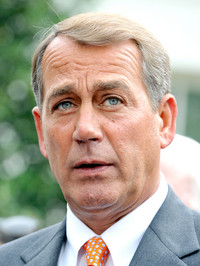
Representative John Boehner of Ohio. Photographer: Ron Sachs/Pool via Bloomberg

Nov. 17 (Bloomberg) -- Richard Clarida, global strategic adviser at Pacific Investment Management Co., talks about the Federal Reserve's quantitative easing strategy. Clarida, speaking with Tom Keene on Bloomberg Television's "Surveillance Midday," also discusses European debt markets and U.S. fiscal policy. (Source: Bloomberg)
The four top Republicans in Congress wrote to Federal Reserve Chairman Ben S. Bernanke today expressing “deep concerns” over the central bank’s second- round of Treasury bond purchases.
“While intended to improve the short-term growth of the U.S. economy and help maintain a stable price level, such a measure introduces significant uncertainty regarding the future strength of the dollar,” the letter said. The purchases could “result both in hard-to-control, long-term inflation and potentially generate artificial asset bubbles.”
The letter, dated today, was signed by House Republican leader John Boehner of Ohio, House Republican Whip Eric Cantor of Virginia, Senate Republican leader Mitch McConnell of Kentucky, and Senate Republican Whip Jon Kyl of Arizona. A copy of the letter was obtained by Bloomberg News.
U.S. central bankers voted Nov. 3 to inject another $600 billion of reserves into the banking system through purchases of U.S. Treasury debt in an effort to steer the economy away from deflation and support growth. The second round of purchases followed a previous $1.7 trillion program.
The top Republicans said the second round of purchases is “giving the impression that the Federal Reserve will keep making new and different attempts to boost the short-term prospects for the economy.”
Bernanke met with Senate Banking Committee members on Capitol Hill today. Bernanke told the lawmakers that he won’t let inflation “get out of control,” Senator Evan Bayh told reporters when asked to describe Bernanke’s comments.
Corker Proposal
Yesterday, Republicans Bob Corker, a senator from Tennessee, and Representative Mike Pence of Indiana held a joint press conference on their proposal to remove the Fed’s full employment mandate and focus the central bank on stable prices alone.
The Fed chairman had the benefit of weak inflation data today to explain his position.
The consumer-price index increased 0.2 percent in October, less than forecast by economists, after a 0.1 percent rise the prior month, the Labor Department said today in Washington.
Excluding food and fuel, so-called core costs increased 0.6 percent from October 2009, the smallest gain on record. U.S. housing starts fell 12 percent last month to a 519,000 annual rate, the fewest since a record low reached in April 2009, the Commerce Department said today.
To contact the reporters on this story: Craig Torres in Washingtont ; Laura Litvan in Washington at [email protected].
To contact the editor responsible for this story: Christopher Wellisz at [email protected]
 Rate this Page