Sales of U.S. Existing Homes Jump More Than Estimated to Seven-Month High
By -
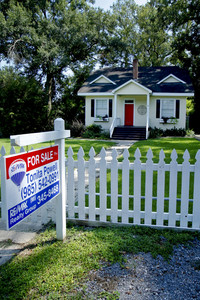
Buyers are returning to the housing market after a government tax credit expired in the middle of 2010, indicating the drop in prices and cheap lending rates are making homes more affordable. Photographer: Derick E. Hingle/Bloomberg

Jan. 20 (Bloomberg) -- David Kelly, chief market strategist for JPMorgan Funds, discusses the U.S. financial industry, stock market and housing outlook. He talks with Betty Liu and Jon Erlichman on Bloomberg Television's "In the Loop." Larry Levin, president of Trading Advantage, also speaks. (Source: Bloomberg)
Sales of U.S. previously owned homes jumped more than forecast in December as buyers tried to lock in low mortgage rates before the economic recovery pushed borrowing up further.
Purchases of existing houses, which are tabulated when a contract closes, increased 12 percent to a 5.28 million annual rate, the most since May and exceeding the highest estimate of economists surveyed by Bloomberg News, figures from the National Association of Realtors showed today in Washington. The median price dropped 1 percent from a year earlier, and the share of sales represented by foreclosures climbed.
Buyers are returning to the housing market after a government tax credit expired in the middle of 2010, indicating the drop in prices and cheap lending rates are making homes more affordable. At the same time, unemployment in excess of 9 percent and record foreclosures are among concerns that have prompted Federal Reserve policy makers to follow through with a second round of quantitative easing.
“Home sales are improving slowly, but surely,” said Aaron Smith, a senior economist at Moody’s Analytics Inc. in West Chester, Pennsylvania. “We really need to see job creation pick up to ensure housing continues to recover. Housing clearly is still a weak spot in the economy.”
For all of last year, purchases decreased to 4.91 million, the fewest since 1997.
Improving Economy
Other reports showed a drop in the number of Americans filing claims for jobless benefits, a bigger-than-projected increase in the index of leading indicators and continued factory expansion in the area covered by the Fed Bank of Philadelphia.
Applications for jobless benefits decreased 37,000 in the week ended Jan. 15, the biggest decline since February 2010, to 404,000, Labor Department figures showed.
The Conference Board’s gauge of the outlook for the next three to six months rose 1.0 percent after a 1.1 percent gain in November, the New York-based group said. The December reading, the sixth consecutive monthly increase, exceeded the 0.6 percent gain in the median forecast of economists surveyed.
The Fed Bank of Philadelphia’s general economic index fell to 19.3 from 20.8 last month. Readings greater than zero signal expansion in the area covering eastern Pennsylvania, southern New Jersey and Delaware.
Shares Down
Stocks fell, with the Standard & Poor’s 500 Index dropping a second day, as concern China will raise interest rates weighed on commodity producers, overshadowing better-than-estimated jobless-claims and home-sale reports. The 500 Index fell 0.5 percent to 1,275.8 at 10:30 a.m. in New York. Treasury securities fell, sending the yield on the benchmark 10-year note up to 3.40 percent from 3.34 percent late yesterday.
Existing home sales were forecast to rise to a 4.87 million rate in December, according to the median of 73 forecasts in a Bloomberg News survey. Economists’ estimates ranged from 4.5 million to 5.07 million after November’s 4.68 million pace.
The median price decreased to $168,800 from $170,500 in December 2009.
The number of previously owned homes on the market dropped 4.2 percent to 3.56 million. At the current sales pace, it would take 8.1 months to sell those houses compared with 9.5 months at the end of the prior month.
Month’s supply in the eight months to nine months range is consistent with stable home prices, the group has said.
Higher Rates
The average rate on a 30-year fixed mortgage was 4.74 percent this week, according to figures from Freddie Mac. The rate reached 4.17 percent in early November, the lowest since records began in 1972.
The jump in rates “provided some urgency” to buyers, Lawrence Yun, the Realtors’ group’s chief economist said in a press conference. The initial increase in borrowing costs “generally induces people to make the decision earlier,” said Yun, although a sustained increase may eventually hurt demand.
The share of sales that reflected distressed properties rose to 36 percent in December from 33 percent in prior months, said Yun. Increasing demand for foreclosed properties accounted for the bulk of the gain, he said, which also included more short sales.
The housing industry is trying to stabilize after demand see-sawed due to a buyer tax incentive of as much as $8,000, which required contracts to be signed by April 30 of 2010 and closed by the end of September. Existing-home sales slumped to a 3.84 million rate in July 2010, the weakest in a decade’s worth of record keeping, reflecting the expiration of the credit.
Credit’s Influence
Earlier, purchases had surged to an almost three-year high 6.49 million pace in November 2009, the month the tax credit was originally due to end. It was subsequently extended.
A lack of sales and an overhang of unsold houses are discouraging builders from taking on projects. Housing starts fell in December to a 529,000 annual rate, the lowest level since October 2009, Commerce Department figures showed yesterday.
Lennar Corp., the third-largest U.S. homebuilder by revenue, is among companies bracing for a slow rebound. The Miami-based builder on Jan. 11 reported fourth-quarter profit that beat analyst estimates on cost cuts and earnings from its distressed-investing unit.
“The housing recovery will traverse a long and bumpy road,” Stuart Miller, chief executive officer, said in a conference call that day. Still, “we’ve seen some early signs of gradual stabilization in the market.”
Jobless Rate
An unemployment rate of at least 9.4 percent since May 2009 is fueling a supply of distressed properties. The number of homes receiving a foreclosure filing will climb about 20 percent in 2011, reaching a peak for the housing crisis, according to RealtyTrac Inc. an Irvine, California-based data seller.
“Activity in residential real estate and new home construction remained slow across all Districts,” the Fed said Jan. 12 in its Beige Book report, based on anecdotal information that central bankers will use to determine policy at their meeting next week.
To contact the reporter on this story: Shobhana Chandra in Washington at [email protected]
To contact the editor responsible for this story: Christopher Wellisz at [email protected]
Sponsored Links
Advertisement
Advertisement
Advertisements
Sponsored Links
 Rate this Page