American Markets Preferred in Global Poll Showing New Investor Confidence
By -
Wall Street has benefited from the improved economic news, with the Standard & Poor’s 500 Index rising for seven of the last eight weeks. Photographer: Ramin Talaie/Bloomberg
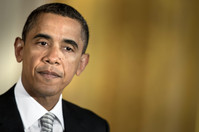
Jan. 25 (Bloomberg) -- President Barack Obama is gaining popularity among investors, as 53 percent now view him favorably, up from 49 percent in November, according to a quarterly poll of 1,000 Bloomberg customers who are investors, traders or analysts. Separately, global investors are taking more risks with their money and targeting the U.S. as one of the best places to put their funds. Some two in five investors pick stocks as the asset class that will offer the best returns over the next year, according to the Bloomberg Global Poll conducted Jan. 20-24. Bloomberg's Deirdre Bolton reports. (Source: Bloomberg)

Jan. 24 (Bloomberg) -- Bob Janjuah, co-head of cross-asset allocation strategy at Nomura International Plc, talks about the U.S. stock market and economy. Janjuah, speaking with Erik Schatzker on Bloomberg Television's "InsideTrack," also discusses the outlook for the Irish government and Federal Reserve monetary policy. (Source: Bloomberg)

Jan. 21 (Bloomberg) -- Don Wordell, a fund manager at RidgeWorth Capital Management Inc., discusses the outlook for the U.S. financial industry and stock market. He talks with Matt Miller, Carol Massar, Julie Hyman and Adam Johnson on Bloomberg Television's "Street Smart." Michael Seery of Seery Futures also speaks. (Source: Bloomberg)
Global investors are taking more risks with their money and targeting the U.S. as one of the best places to put their funds as they grow increasingly confident in the economic outlook.
More than two of five of those surveyed say they are seeing more opportunities to make money, according to a quarterly Bloomberg Global Poll of 1,000 investors, analysts and traders who are Bloomberg subscribers. That’s the highest level since the poll began in July 2009 and compares with less than one in three who are still hunkering down. The rest of investors in the poll conducted Jan. 20-24 describe the economic environment as getting back to normal.
“The recovery is materializing and global profit margins for 2011 probably are set to reach a new record,” says Angelo Meda, a participant in the poll and a portfolio manager for Banknord in Milan, which oversees more than $1 billion.
As the financial and economic elite gather in Davos for the annual meeting of the World Economic Forum, much of the optimism is centered on the U.S. in particular and world equity markets in general. Investors have soured on gold, traditionally a safe haven in times of uncertainty, while growing more wary about China. And for the first time since the survey began, Asian poll participants aren’t the ones most willing to take risks; Europeans are.
‘Dramatically’ Emerging
“The U.S. will emerge dramatically from the crisis,” says Henry Littig, chief executive officer of Henry Littig Global Investments AG in Cologne, Germany, who took part in the poll. “I expect the unemployment rate to drop significantly in 2011.”
The U.S. economy has picked up steam since the last global poll in November, with industrial production and consumer spending rising and jobless claims falling. Gross domestic product probably expanded at 3.5 percent annual pace in the fourth quarter, up from 2.6 percent in the previous three months, according to the median estimate of 67 economists surveyed by Bloomberg News.
Wall Street has benefited from the improved economic news, with the Standard & Poor’s 500 Index rising for seven of the last eight weeks.
The U.S. came out on top when survey participants were asked to name the best countries to invest their money over the next year. More than 35 percent cited the U.S., followed by China, with 26 percent, and Brazil, with 23 percent. The European Union was seen by the most respondents as the market offering the worst returns.
Seeking Dollar Assets
The U.S. trailed China, Brazil and India as one of the most attractive places to invest in the last survey in November. India, which is suffering from rising inflation, took a knock in the latest poll, with 18 percent of investors picking it as offering the best opportunities over the next year, down from 29 percent in November.
More than half of those polled describe the U.S. economy as improving, up from just a third who said that in November. Almost two-thirds predict the S&P 500 index will rise over the next six months. Less than 20 percent see it falling.
“Given that Europe is still haunted by its sovereign debt problem and some emerging markets could face high inflation and depreciation of their currencies, dollar assets would offer relatively promising returns with low foreign-exchange risk,” says Iris Yao, a trader for Nomura Securities Co. in Tokyo who took part in the survey.
Global Economy
Overall, 49 percent of respondents said the global economy is improving. That’s a new high for the poll and up from 44 percent in November. More than three-quarters said inflation was a greater threat than deflation over the next 12 months.
Equities get high marks in the poll. Some two in five investors pick stocks as the asset class that will offer the best returns over the next year. More than 55 percent say they will increase their exposure to shares over the next six months.
Stock prices “currently are vastly undervalued as compared with corporate earnings,” says Tetsuo Jerry Yoshikoshi, a poll participant and senior economist with Sumitomo Mitsui Banking Corp. in Singapore.
Bonds will offer the worst returns over the next year, according to 45 percent of those surveyed. Some three in five investors forecast that the yield on the U.S. Treasury’s 10-year note, which moves inversely to its price, will rise over the next six months. The 10-year note yield was little changed yesterday at 3.40 percent.
‘No Fundamental Value’
Gold has also lost luster, with almost twice as many investors saying they will reduce their exposure to the metal over the next six months as increase it. More than half say the gold market is a bubble.
Gold has “no fundamental value since it doesn’t produce any cash flow to the holder,” says Kevin Baldauf, a portfolio manager at Wafra Investment Advisory Group in New York who responded to the poll.
Gold futures for February delivery traded at $1,333 at 4:39 p.m. yesterday in New York. Gold futures have risen more than 50 percent since the beginning of 2009.
Some of the enthusiasm about investing in China has also been tempered. One in five investors say the world’s most populous country will offer the worst returns over the next year. That’s up from about one in 10 who felt that way in November.
China’s stocks fell yesterday, extending last week’s drop, after China International Capital Corp. said inflation will jump this month and that investors should be cautious over smaller companies because of valuations.
Asia Less Bullish
Asian investors in general are less optimistic than they have been. Forty-three percent say they’re taking more risks, down from 47 percent who said that in November. About half of European investors say they’re taking more chances with their money, while 40 percent of U.S. respondents say the same.
Chinese President Hu Jintao and German Chancellor Angela Merkel got the highest marks from poll respondents for pursuing policies conducive to investment. Sixty percent voiced optimism about each of the leader’s programs. More than half felt that way about U.K. Prime Minister David Cameron.
President Barack Obama’s standing increased in the poll: investors were roughly evenly split between optimism and pessimism over his policies. In November, more than 60 percent were down on Obama. A majority of investors -- 54 percent -- don’t believe the U.S. has done enough to prevent another financial crisis.
Investors remain downbeat on French President Nicolas Sarkozy, with more than three in five voicing pessimism about his policies.
The quarterly Bloomberg Global Poll of investors, traders and analysts was conducted by Selzer & Co., a Des Moines, Iowa- based firm, and is based on interviews with a random sample of 1,000 Bloomberg subscribers. It has a margin of error of plus or minus 3.1 percentage points.
To contact the reporters on this story: Rich Miller in Washington [email protected] Catherine Dodge in Washington at [email protected]
Sponsored Links
Advertisement
Advertisement
Advertisements
Sponsored Links
 Rate this Page