Republicans, Fed Clash on Impact of Party's Planned Spending Cuts on Jobs
By -
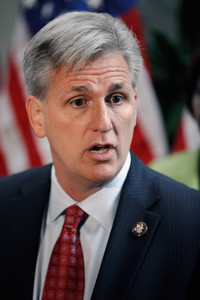
Majority Whip Kevin McCarthy. Photographer: Chip Somodevilla/Getty Images
U.S. Representative Kevin McCarthy thought he had an ally in Federal Reserve Chairman Ben Bernanke on the impact that Republican budget cuts will have on jobs.
McCarthy, of California, the third-ranking House Republican, said this week the spending cuts won’t cost the nation jobs, pointing to Bernanke for support. Within hours, Bernanke testified on Capitol Hill that the budget reductions may lead to the loss of 200,000 jobs.
The Fed chief said the House Republican plan to slash $61 billion from 2011 government spending could also subtract “a couple of tenths” of a percentage point from U.S. economic growth over several years.
“We need to address the deficit; that’s very important,” Bernanke told the House Financial Services Committee in a March 2 hearing. “But I think it would be most effective if we did that over a timeframe of five or 10 years and not try to do everything immediately.”
Bernanke’s words will pose a danger for Republicans, who say their top priorities are jobs and cutting spending, if voters see them in conflict with the head of the central bank.
The House approved the Republican plan last month, with all but six party members backing the proposal. Senate Republicans say they are seeking the same level of reductions in talks with Democratic leaders and the White House. The plan includes cuts of 10 percent or more in hundreds of programs.
Don’t Believe It
McCarthy and other Republicans say their budget cutting won’t increase the nation’s unemployment rate, which declined to 8.9 percent in February.
“I don’t believe the $61 billion is going to be a short- term hit on jobs,” McCarthy, 46, the House majority whip, said at a Bloomberg News breakfast on March 2.
McCarthy also dismissed analyses by Goldman Sachs Group Inc. (GS) and Mark Zandi, chief economist for Moody’s Analytics, that said the Republican budget move would shed jobs and slow economic growth. He suggested that Bernanke was more credible.
“I think Bernanke refuted that it’s going to be a job loss,” McCarthy said. “Any time that you create private-sector jobs over the public sector, you’re in a much stronger position.”
Bernanke, 57, later testified on Capitol Hill.
Republicans have struggled to balance calls for steep spending cuts from newly elected members of their caucus, those aligned with a Tea Party movement urging deep reductions in government spending, with the political fallout that could come from possible job losses.
‘Irresponsible Cuts’
Democrats seized on the potential losses today, releasing a state-by-state breakdown of what they say would be a decrease in jobs under the Republican budget plan.
“This map shows exactly how House Republicans’ irresponsible cuts will hit home,” said Senator Charles Schumer of New York, who heads the Democratic Policy and Communications Committee.
A national survey by the Wall Street Journal and NBC News found less than one-quarter of Americans support significant cuts in two of the biggest pieces of the budget, Social Security or Medicare. The poll of 1,000 adults was conducted Feb. 24-28, with a 3.1-percentage-point margin of error.
House Speaker John Boehner came under fire last month after he appeared insensitive to losses of federal government jobs that could result from the Republican spending plan.
‘So Be It’
“If some of those jobs are lost in this, so be it,” the Ohio Republican told reporters on Feb. 15. “We’re broke. It’s time for us to get serious about how we’re spending the nation’s money.”
The Federal Reserve’s estimate of job losses is significantly lower than the study of the proposal by Zandi, who frequently analyzes the economic impact of legislation for House Democrats. Zandi also worked as an economic adviser for Republican Senator John McCain’s 2008 presidential campaign.
Zandi said the measure would cost the country 700,000 jobs by the end of 2012 and reduce real economic growth this year by 0.5 percentage points and by 0.2 percentage points next year.
“Significant government spending restraint is vital, but given the economy’s halting recovery it would be counterproductive for that restraint to begin until the U.S. is creating enough jobs to lower the unemployment rate,” Zandi said.
An independent analysis released by Goldman Sachs last month found that the Republican proposal would reduce economic growth by 1.5 to 2 percentage points during the second and third quarters of this year.
Realistic Analysis
Bernanke attributed the lower Federal Reserve estimates to some “differences in assumptions.”
“We’ve tried to do a realistic analysis of what those cuts would do over a couple of years,” he said.
Republicans say the positive effect that making a serious effort to tackle the deficit would have on long-term economic growth would outweigh any short-term job losses.
“The deficit and debt are key issues to get our economy back on track, and that’s the intangible that has to be factored in,” said Senator Rob Portman, an Ohio Republican. “What is the real short-term hit if the market’s going to respond favorably to us getting our act together?”
Boehner called Zandi the “pet economist” of House Democratic Leader Nancy Pelosi of California, citing his support for an economic-stimulus bill that the White House once estimated would keep unemployment below 8 percent. Boehner cited a statement signed by 150 economists sent to President Barack Obama calling for spending cuts.
Stanford University economist John Taylor, a Treasury undersecretary under former President George W. Bush, says both Zandi and Goldman Sachs relied on a flawed methodology. He wrote that he found “no convincing evidence” that the budget-cutting bill would reduce employment or economic growth.
To contact the reporter on this story: Lisa Lerer in Washington at or [email protected].
To contact the editor responsible for this story: Mark Silva at [email protected]
Sponsored Links
Advertisement
Advertisement
Advertisements
Sponsored Links
 Rate this Page