S&P; 500 Erases Advance for Year as Nikkei Futures Point Lower; Yen Climbs
By -
A trader works on the floor of the New York Stock Exchange in New York. Photographer: Jin Lee/Bloomberg

March 16 (Bloomberg) -- Bloomberg's Deborah Kostroun reports on the performance of the U.S. equity market today. U.S. stocks retreated, sending the Standard & Poor’s 500 Index to the lowest level since December, amid concern that Japan’s nuclear crisis will worsen. Bloomberg's Pimm Fox also speaks. (Source: Bloomberg)

March 16 (Bloomberg) -- Michael Aronstein, president of Marketfield Asset Management, and Jason Trennert, chief investment strategist at Strategas Research Partners, talk about the outlook for Japan and U.S. valuations. They speak with Tom Keene on Bloomberg Television's "Surveillance Midday." (Source: Bloomberg)
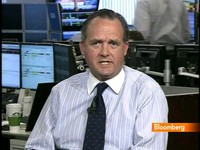
March 16 (Bloomberg) -- John O'Donoghue, head of equities at Cowen & Co., talks about the impact of Japan's earthquake, tsunami and nuclear crisis on the U.S. stock market. O'Donoghue speaks with Margaret Brennan on Bloomberg Television's "InBusiness." (Source: Bloomberg)

March 16 (Bloomberg) -- Mary Ann Bartels, head of U.S. technical analysis at Bank of America-Merrill Lynch, talks about the outlook for stocks and crude oil prices. She speaks with Carol Massar and Matt Miller on Bloomberg Television's "Street Smart." (Source: Bloomberg)

March 16 (Bloomberg) -- Steven Kroll, managing director at Monness Crespi Hardt & Co., and Lincoln Ellis, chief investment officer at Strategic Financial Group, talk about the outlook for stocks. They speak with Carol Massar and Matt Miller on Bloomberg Television's "Street Smart." (Source: Bloomberg)

March 16 (Bloomberg) -- Stefan Keitel, chief investment officer at Credit Suisse Asset Management, talks about his strategy for Japanese equities. He speaks with Andrea Catherwood on Bloomberg Television's "Last Word." (Source: Bloomberg)

March 16 (Bloomberg) -- Richard Cookson, global chief investment officer at Citigroup Inc.’s Private Bank in London, talks about the outlook for Japanese stocks. He speaks with Maryam Nemazee on Bloomberg Television's "The Pulse." (Source: Bloomberg)

March 16 (Bloomberg) -- Michael Holland, chairman of Holland & Co., discusses his investment strategy and the impact of Japan's natural disasters and damaged nuclear reactors on global financial markets. Holland speaks with Betty Liu, Sheila Dharmarajan and Dominic Chu on Bloomberg Television’s "In the Loop." (Source: Bloomberg)

March 16 (Bloomberg) -- Faysal Itani, deputy head of forecasting for the Middle East at Exclusive Analysis, discusses the state of emergency in Bahrain and the intervention by Saudi Arabian-led military forces. He talks from Beirut with Mark Barton on Bloomberg Television's "Countdown." (Source: Bloomberg)

March 16 (Bloomberg) -- Bahrain security forces used tear gas to drive protesters from their rallying point at the central Pearl Roundabout in Manama, and state television said two policemen were killed. Bloomberg's Lara Setrakian reports. (Source: Bloomberg)
U.S. stocks sank, erasing the 2011 gain for the Standard & Poor’s 500 Index, and Treasuries rallied as Japan’s nuclear crisis worsened. The yen rose to a post-World War II high versus the dollar on speculation investors will buy the currency to fund rebuilding projects.
The S&P 500 lost 1.95 percent to 1,256.88 at 4 p.m. in New York, leaving it down 0.1 percent on the year. The iShares MSCI Japan Index Fund, which tracks the nation’s stocks, slumped 3.7 percent and Nikkei 225 futures signaled losses for Japan’s stocks when trading resumes in Tokyo. Ten-year Treasury yields fell 10 basis points to 3.20 percent, the lowest since December. The yen appreciated against all 16 major peers, rising to as strong as 79.24 per dollar after U.S. markets closed.
Equities extended their retreat as U.S. Nuclear Regulatory Commission Chairman Gregory Jaczko told lawmakers that all the water has drained from the spent-fuel pool at a crippled atomic reactor north of Tokyo and high levels of radiation have been released. The United Nations’ nuclear agency planned to call an emergency meeting to discuss the crisis and said the three reactor cores containing fuel are damaged.
“The selling today is exacerbated by the nuclear situation, which makes it much more difficult to assess Japan,” said Christopher Sheldon, the Boston-based director of investment strategy at BNY Mellon Wealth Management, which oversees $166 billion globally. “Investors are selling on the appearance of a negative situation with the nuclear reactors and you can’t say it’s unfounded because we don’t know how bad this may get.”
IBM Downgrade
The S&P 500 has tumbled 6.4 percent from its 32-month high in February amid concern Japan’s worst earthquake on record and uprisings in the Middle East and northern Africa will derail the global economic recovery. The Chicago Board Options Exchange Volatility Index, which measures the cost of using options to protect against losses in the S&P 500, jumped 21 percent today to 29.4 and is up 46 percent this week in its biggest three-day gain since May.
Technology and industrial stocks led declines of at least 1.4 percent in all 10 industry groups in the S&P 500, which fell to the lowest level since Dec. 23. International Business Machines Corp. sank 3.8 percent for the biggest drop in the Dow Jones Industrial Average after Sanford C. Bernstein & Co. reduced the shares to “market perform” from “outperform.”
All 30 Dow stocks fell, sending the average down 242.12 points, or 2 percent, to 11,613.3 in its biggest plunge since August.
Housing Slump
Eleven of 12 stocks in an S&P gauge of homebuilders dropped after Commerce Department data showed housing starts fell 22.5 percent to a 479,000 annual rate in February, with declines in all regions. The decrease from January was the biggest since March 1984 and larger than the median forecast in a Bloomberg News survey of economists. A separate Labor Department report showed the producer-price index climbed 1.6 percent in February from the prior month, the most since June 2009.
U.S. companies at risk from lost sales in Japan helped lead declines. Hartford Financial Services Group Inc. (HIG) declined 3.3 percent. The U.S. insurer made bullish bets on Japan earlier this year. General Electric Co. slumped 3.4 percent, the second biggest decline in the Dow, as the company’s goal of broadening its $1 billion nuclear services and parts business came at risk from the potential nuclear fallout in Japan.
Retailers with operations in Japan, such as Coach Inc. (COH) and Tiffany & Co., declined on speculation store closures and shortened hours will reduce sales.
Japanese Futures
Futures on the Nikkei 225 traded at 8,530 in Chicago, 4.7 percent below the closing level of 8,950 in Singapore.
IAEA Chief Yukiya Amano is flying to Tokyo to talk with authorities today and will return for the meeting as soon as possible, he told reporters in Vienna yesterday. It will be the first extraordinary meeting of the agency’s 35-member board since his election to succeed Mohamed ElBaradei two years ago.
The U.S. Embassy recommended American citizens living within 50 miles of the damaged power plant evacuate or take shelter indoors as a precaution.
“We believe that the secondary containment has been destroyed and there is no water in the spent-fuel pool,” Jaczko said today at a hearing of a House Energy and Commerce Committee panel.
The Nikkei 225 rebounded 5.7 percent in today’s trading in Tokyo after plunging 16 percent on March 14 and 15, the worst two-day drop since 1987. The gauge plunged 11 percent yesterday as record trading volume on the main section of the Tokyo Stock Exchange drove the average price of shares in the Nikkei to 14.7 times estimated profit, the lowest level since November 2008.
Asian Shares
Benchmark equity indexes in South Korea, Taiwan and India rallied at least 1 percent. Credit-default swaps insuring bonds of Tokyo Electric Power Co., which operates the Fukushima plant, fell 83.1 basis points to 303.9 basis points as of 11:50 a.m. in New York after reaching a record yesterday, while the price to insure Japanese government debt slipped 3.5 basis points to 110.2 basis points, according to data provider CMA.
The Stoxx Europe 600 Index slid 1.6 percent, erasing an earlier gain, as banks and auto companies declined. BNP Paribas SA and HSBC Holdings Plc led lenders lower and Renault SA and Bayerische Motoren Werke AG lost more than 2 percent.
The MSCI Emerging Markets Index rose 0.3 percent as valuations near the lowest level in nine months lured investors and rising oil boosted energy companies. The 21-country gauge closed at 11 times estimated earnings yesterday, within 2 percent of its cheapest level since May, according to data compiled by Bloomberg.
Persian Gulf
The Bloomberg GCC 200 Index (BGCC200) of Persian Gulf shares gained 0.1 percent after falling 2.5 percent yesterday. Bahrain closed its stock exchange as clashes between security forces and anti- government protesters intensified.
Oil climbed 0.8 percent to $97.98 a barrel, paring gains as concern grew that Japan’s nuclear crisis will hurt economic growth. Crude rose as much as 2.5 percent earlier as escalating violence in Bahrain raised concern that unrest will spill into Saudi Arabia, the world’s biggest crude-exporting country.
The euro fell against 13 of its 16 most-traded peers, weakening 1.7 percent to 111.08 yen. Norway’s krone rose 0.3 percent against the euro after the nation’s central bank left its overnight deposit rate unchanged at 2 percent.
The extra yield investors demand to hold Portugal’s 10-year bonds instead of benchmark German bunds rose 14 basis points to 441 basis points.
Portugal, Egypt Ratings
The Iberian nation’s credit rating was cut two steps by Moody’s Investors Service yesterday to A3, four steps from so- called junk status. Moody’s cited Portugal’s “subdued growth prospects” and “implementation risks for the government’s ambitious fiscal consolidation targets.” The change brings the rating company’s ranking for Portugal to the same level as Standard & Poor’s, with Fitch Ratings two steps higher.
Egypt had its bond ratings cut one level at Moody’s Investors Service on political instability and the impact on the economy. Egypt’s foreign and local currency bond ratings were lowered to Ba3, three levels below investment grade, from Ba2, the ratings company said in a statement today. The outlook remains negative, it said.
Russia and Poland raised less than 50 percent of their targets at government bond auctions today as Japan’s deepening nuclear crisis, escalating violence in Bahrain and Portugal’s credit-rating downgrade unsettled investors.
Russia sold 10.2 billion rubles ($356 million) of bonds known as OFZs that mature in 2016 after seeking to raise as much as 30 billion rubles, the Finance Ministry said today. Poland issued a combined 1.03 billion zloty ($354 million) of 2021 floating-rate notes and 2023 inflation-linked bonds after saying it was prepared to offer as much as 2.5 billion zloty of debt.
To contact the reporters on this story: Nikolaj Gammeltoft in New York at [email protected]; Inyoung Hwang in New York at [email protected].
To contact the editor responsible for this story: Nick Baker at [email protected]
Sponsored Links
Advertisement
Advertisement
Advertisements
Sponsored Links
 Rate this Page