Allies Expand Libya No-Fly Zone as Strikes Force Halt in Loyalist Attacks
By -
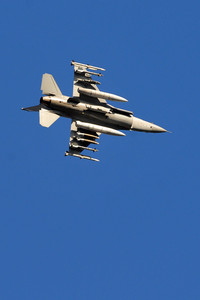
A U.S. F-16 takes off from the Aviano air base on Monday. Photographer: Guiseppe Cacace/AFP/Getty Images

March 21 (Bloomberg) -- Richard Falkenrath, a principal at the Chertoff Group and a Bloomberg Television contributing editor, discusses the outlook for international military intervention in Libya. Falkenrath talks with Erik Schatzker on Bloomberg Television's "InsideTrack." (Source: Bloomberg)
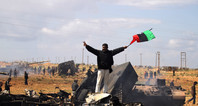
A Libyan rebel waves the rebellion flag as he stands over wrecked military vehicles hit by French warplanes on March 20, 2011. Photographer: Patrick Baz/AFP/Getty Images
Allied forces are expanding their air campaign over Libya after strikes forced fighters loyal to leader Muammar Qaddafi to halt their attacks against the rebel stronghold of Benghazi.
President Barack Obama said the U.S. expects to hand over military leadership to allies within days once the initial phase -- knocking out air defenses to support the no-fly zone -- is complete.
The most recent military actions “are focused on extending the no-fly zone southward, then westward from Benghazi,” General Carter Ham, the U.S. commander for combat operations against Libya, said in Stuttgart, Germany.
“There is no intent to completely destroy the Libyan military,” Ham, who heads the U.S. Africa Command, told reporters at the Pentagon via teleconference. “The mission is to protect civilians. We have no mission to support opposition forces if they were to engage in offensive operations.”
Rebel forces pushed out of Benghazi toward the outskirts of the city of Ajdabiya, which is surrounded by pro-Qaddafi forces, the Associated Press reported today.
U.K. Foreign Secretary William Hague today refused to rule out the possibility that U.K. special forces will be deployed as the allied mission grows, saying only that there would be no occupation of the country. Coalition forces used elite soldiers in Afghanistan to target tanks and other heavy weapons for precision air attacks.
Oil Prices
The allied bombardment, which began March 19, moved oil markets today as fighting threatened to prolong supply disruptions. Crude oil for April delivery increased $1.26 to $102.33 a barrel on the New York Mercantile Exchange.
Obama, speaking in Santiago, Chile, said the U.S. will hand over the military leadership role “in a matter of days, not a matter of weeks.”
The option of having the North Atlantic Treaty Organization take charge may hinge on reservations expressed by Turkish Prime Minister Recep Tayyip Erdogan.
Both Britain and France supported giving leadership to NATO, which requires unanimous approval from its 28 member countries, including Turkey. Italian foreign minister Franco Frattini said that unless NATO takes control of the operation, Italy would “reflect” on its decision to permit use of its bases launching the attacks.
Arab Politics
Complicating matters, Arab League allies, who called for the no-fly zone, may not want to operate under NATO’s leadership, U.S. Defense Secretary Robert Gates said at a news conference yesterday.
The coalition ordered Qaddafi to pull his forces back from major cities after weeks of fighting that has left hundreds dead in the bloodiest of the popular uprisings to have swept the Middle East this year.
Russian Prime Minister Vladimir Putin criticized the allied attacks as a “medieval call for a crusade,” an inflammatory phrase in Muslim nations that Russian President Dmitry Medvedev dismissed as “unacceptable.” Their conflict came a year before the next presidential election, in which both men have said they may run.
Allied air power forced Qaddafi’s loyalists to pull back from Benghazi after recapturing almost all the towns they lost during the uprising. The coalition, which includes the U.S., the U.K. and France, wiped out Libyan air defenses with Raytheon Co. (RTN) Tomahawk cruise missiles while allied jets hit airfields and some of Qaddafi’s tanks.
Libyan Targets
A cruise missile smashed into Qaddafi’s residential compound, knocking down half of a three-story administrative building, the AP reported. It wasn’t immediately known if there were any casualties, the agency said.
“I’m not going to get drawn into the detail of who might be targeted because I don’t think it is right,” Hague told BBC Radio 4’s “Today” program when asked if the UN resolution barred attacks on Qaddafi. “I don’t think in a conflict and the enforcement of the UN resolution, to give people all the details of what might or might not be targeted, is wise.”
U.S. Defense Secretary Robert Gates said yesterday the campaign should be limited to the terms of the resolution rather than being broadened to target Qaddafi directly.
Qaddafi’s Life
The chief of Britain’s defense staff, General David Richards, said Qaddafi can’t be directly targeted.
“It’s not allowed under the UN resolution and it’s not something I want to discuss further,” Richards told BBC News television today.
Regarding the possible deployment of special forces, Hague said that “circumstances can arise when these sorts of things happen. It would be foolish to exclude it.”
The British military launched new strikes on Libyan targets overnight.
“For a second time, the U.K. has launched guided Tomahawk land attack missiles from a Trafalgar-class submarine in the Mediterranean as part of a coordinated coalition plan to enforce the resolution,” the chief U.K. spokesman, Major General John Lorimer, said in an e-mailed statement early this morning.
U.S. Vice Admiral Bill Gortney said Spain, Belgium, Denmark and Qatar have joined the coalition. The U.S., the U.K., France, Italy and Canada have at least 25 ships off the coast of Libya.
Spanish Fighters
Two Spanish fighters and a refueling aircraft undertook their first mission as part of the coalition, the Spanish Defense Ministry said.
Attacks have been “highly successful,” Lorimer said.
“Although they claimed a cease-fire yesterday, there is no evidence” of a change of policy from Qaddafi, Lorimer said. “Opposition sources are saying that Qaddafi is removing forces from Benghazi and targeting elsewhere.”
A United Nations resolution passed on March 17 permits “all necessary measures” short of an occupation to protect civilians from violence. Western leaders haven’t said what they’ll do if the no-fly zone fails to force Qaddafi to comply.
Unrest continued in Yemen today, as some army leaders and diplomats abandoned the regime of President Ali Abdullah Saleh, three days after a crackdown that left dozens dead.
Military officers including Mohammed Ali Muhssein, commander of the eastern region, and Hamid al-Qushaibi, head of an armored brigade, have “announced their support for the revolution,” said Mohammed al-Sabri, an opposition leader. Dozens of army and internal security officials, including three generals, have joined protesters calling for an end to Saleh’s rule three-decade rule, al-Jazeera television reported.
To contact the reporters on this story: Brendan McGarry in Washington at [email protected]; Kitty Donaldson in London at [email protected]
To contact the editors responsible for this story: James Hertling at [email protected]; Andrew J. Barden at [email protected]
Sponsored Links
Advertisement
Advertisement
Advertisements
Sponsored Links
 Rate this Page