U.S. Budget Talks Stall Amid Inaction Charges as Shutdown Looms
By -
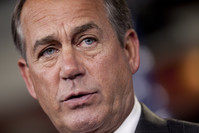
House Speaker John Boehner, a Republican from Ohio, speaks at a news conference in Washington, D.C. Photographer: Andrew Harrer/Bloomberg
Budget talks resumed to avert a U.S. government shutdown, with Vice President Joe Biden meeting tonight with Senate Democratic leaders who are working to craft a spending-cut package Republicans might accept.
Aides to Democratic and Republican lawmakers negotiating a deal are working toward cuts totaling about $33 billion, said a person familiar with the talks. The person cautioned, though, that no firm agreements have been reached.
House Republicans last month passed a budget bill for the remainder of this fiscal year that would cut $61 billion.
Jon Summers, a spokesman for Senate Majority Leader Harry Reid, said many aspects of the package remain to be worked out and no total spending-cut figure has been agreed upon. “There isn’t a final package,” he said.
House Speaker John Boehner, an Ohio Republican, last night instructed aides from his office and the House Appropriations Committee to start negotiating with Democrats on what specifically would be cut, said another person familiar with the talks.
Policy Disputes
A spokesman for Boehner said Republicans aren’t agreeing to any overall amount of cuts until an accord is reached on how a series of policy provisions the House included in its budget bill are addressed. The dozens of so-called riders include a ban on funding this year to implement the health-care overhaul.
“There is no agreement on a number for the spending cuts,” Boehner spokesman Kevin Smith said earlier today. “Nothing is agreed to until everything is agreed to.”
An agreement is needed to extend government operations past April 8, when a stopgap spending measure expires. House Republicans this morning renewed their demand that the Democratic-run Senate produce an alternative to the $61 billion spending-cut plan the House passed last month.
The Republicans unveiled the Government Shutdown Prevention Act in a bid to hold Democrats responsible if no spending agreement is reached. The measure would deem the House’s spending cuts “law of the land” if the Senate fails to take action before the current stopgap spending measure expires, House Majority Leader Eric Cantor told reporters.
“Perhaps that will prod the Senate into joining us in taking care of business here, which is to get our fiscal house in order,” said Cantor, a Virginia Republican. Republicans conceded that the measure, which would also strip lawmakers of pay in the event of a shutdown, was a symbolic gesture.
‘Extreme Minority’
Reid, a Nevada Democrat who has accused House Republican leaders of trying to placate an “extreme minority” of their party in the budget dispute, heralded the resumption of negotiations today.
“Much of the criticism of the process has come from people who aren’t even at the negotiating table,” Reid said on the Senate floor. “I am. And so is Speaker Boehner. I’m glad he’s returned to the conversation.”
Reid said House Republicans “can’t let the Tea Party call the shots” if they “want to move the country forward.” He called for compromise because “neither party can pass a budget without the other party.”
An offer by Senate Democrats and President Barack Obama to accept about $30 billion in spending cuts for the 2011 budget year “still stands,” Reid said. Democrats argue that is within $6 billion of the level House Republican leaders initially sought before their rank-and-file demanded deeper reductions.
Obama Threat
Obama has threatened to veto the House-passed spending measure, arguing the $61 billion in cuts would hurt the fragile economic recovery.
White House spokesman Jay Carney said today there is “ample reason to be optimistic” that budget negotiations will be successful. He also signaled a willingness among Democrats to go beyond $30 billion in cuts if House Republicans agree to drop the policy riders from the budget measure.
“No side is going to get everything it wants,” Carney said. “We’re willing to do more, to cut more.”
Boehner told reporters today that his discussions with the White House had given him “no clue” what would be acceptable to Obama. He also complained that Senate Democrats haven’t made their position clear.
“Now the Senate says ‘we have a plan,’” Boehner said. “Well, great. Pass the damn thing and send it over here and let’s have real negotiations instead of rooting for a government shutdown.”
Earlier this month, the Senate defeated the House-passed spending measure as well as a Democratic alternative.
Previous Shutdown
The last government shutdown occurred in late 1995 and early 1996 in a budget dispute between Democratic President Bill Clinton and the Republican-controlled House and Senate. In its wake, the Republicans suffered the most political blame.
At the weekly House Republican caucus yesterday, there were no calls by any House Republicans to shut down the government if it comes to that, said Representative Tom Cole of Oklahoma. “Our people uniformly want to avoid a shutdown.”
Talks among lawmakers and White House officials last week failed to bridge differences between the $61 billion of cuts in the House Republican bill and the $10 billion Senate Democrats approved as part of two separate stopgap measures that have kept the government operating.
A new Democratic offer of $20 billion more in cuts surfaced earlier this week and would yield $30 billion in spending reductions.
House Republican leaders also have been reaching out to fiscally conservative Democrats known as Blue Dogs on longer- term spending issues, said Representative Mike Ross, an Arkansas Democrat. He said that House Republican Whip Kevin McCarthy, a California Republican, met with him and other Blue Dogs for discussions on ways reduce the government’s debt in years to come.
To contact the reporters on this story: Laura Litvan in Washington at or [email protected]; To contact the reporters on this story: Lisa Lerer in Washington at [email protected]
Sponsored Links
Advertisement
Advertisement
Advertisements
Sponsored Links
 Rate this Page